
A 2030 Legacy Project
Why Alejandro Domínguez is so desperate for a 64-team World Cup?

The 2026 World Cup is barely over but Alejandro Domínguez has already pushed the conversation about the 2030 tournament by boldly asserting it will be a 64-team World Cup. Less that 24 hours after the tense final in East Rutherford the CONMEBOL President tweeted a video declaring that the 2030 Centenary World Cup will come to Uruguay, Argentina and Paraguay as part of a 64 nation competition.

It was a strange declaration, firstly considering that World Cup winners Spain were not mentioned despite being co-hosts with Portugal and Morocco. Secondly it seemed as if the head of the South American confederation was publicly pressuring FIFA President Gianni Infantino. Until now the Italian former lawyer had only said they were examining the possibility and would need further study.
So what is the rush for Alejandro Domínguez and why is he desperate for a 64 team World Cup?
DO CONMEBOL REALLY NEED IT?
CONMEBOL is the smallest of all the FIFA confederations, with just 10 members. With the current 48-team set up they are given 6.5 places meaning that up to 70% of the confederation can qualify. An expanded tournament would essentially mean that every nation qualifies, like they already do for the Copa América. That might seem like a good thing for the smaller countries, especially Venezuela who have never played a World Cup before, but this is hardly something the major players Brazil and Argentina are interested in. On the contrary, the elimination of the eliminatorias would wipe out 90 competitive matches played over two years which would be detrimental to the bigger teams from a sporting standpoint. Imagine if they have to replace the challenges of altitude, extreme heat, hostile fans from classic opponents with friendlies against non-European opposition while UEFA continue to play the Nations League.
The issue is unlikely to be financial either, at least not for CONMEBOL as a whole. In 2024 after the Copa América they posted earnings of US$112m which was a 261% increase y.o.y. Although hosting in the US saw a surge in operating costs, it was outweighed by the TV and sponsorship deals available in North America. Domínguez already plans to bring the 2028 championship back there, for another welcome revenue boost before the next World Cup.
PARAGUAY GATE-CRASHING THE PARTY
The real reason lies closer to home, the home of CONMEBOL and Alejandro Dominguez’s birthplace of Paraguay. Returning to the tweet from the start of this article, why would a Centenary World Cup have a game in the landlocked nation? The original hosts were Uruguay and the final was played between them and Argentina. The Albirroja did compete in the inaugural World Cup, but so did Bolivia, Brazil, Chile and Peru. Why are the guaraníes even part of the conversation?
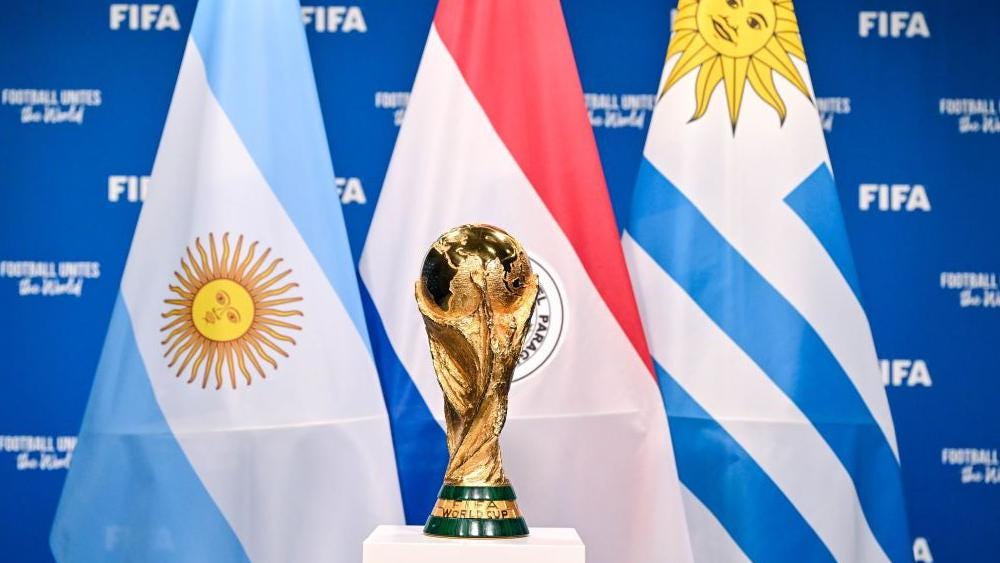
The idea of Uruguay hosting had first been floated in 2005 by then President Tabaré Vázquez to the FIFA head Sepp Blatter. By 2007 Julio Grondona of AFA (Argentina’s Football Federation) supported the idea and offered Argentina as co-host given the unlikelihood of FIFA awarding the tournament to a host nation of just 3 million inhabitants (this was three years before Qatar would be accepted as hosts). By 2016 when Alejandro Domínguez assumed his mandate at the head of CONMEBOL, the two countries had formed a binational commission, backed by their repsective governments, and were seriously preparing for the undertaking of a bid. It was somewhat of a shock then, a year later, when Paraguay tagged along as another co-host.
The original offering was ambitious, especially from Paraguay who had put forward five sites to host games with two of the proposed venues not yet in existence. One has since been built in Encarnación, but not close to FIFA standards while the CONMEBOL stadium that was to sit near their HQ in Luque never came to pass. Ultimately it was too far fetched to convince FIFA members even as Chile joined the bid to add extra venues. In 2024 Spain, Portugal and Morocco were ratified as co-hosts without it going to a vote. The trade off for CONMEBOL was that they still got to “host” the World Cup but were just given three games, one for each bidding country except for Chile who missed out entirely.
FAMILY CLUB TIES
If this unprecedented move from FIFA to award single games on a totally different continent thousands of miles from the main hosts wasn’t enough, there was a bigger surprise waiting. The one game that Paraguay would be hosting was not given to any of the original five venues on the bid. Instead, it was announced that Club Olimpia’s ageing stadium would be totally renovated to FIFA standards to host this showpiece match. It was a coup for the most successful club in Paraguay and even more so for the Domínguez family. Earlier in 2024 the stadium had been renamed the Estadio Osvaldo Domínguez Dibb after Alejandro’s late father. ODD as he is affectionately remembered, was the son of a Syrian immigrant and made his money in tobacco amongst other businesses while guiding Olimpia to the heady heights of Copa Libertadores success on three occassions.
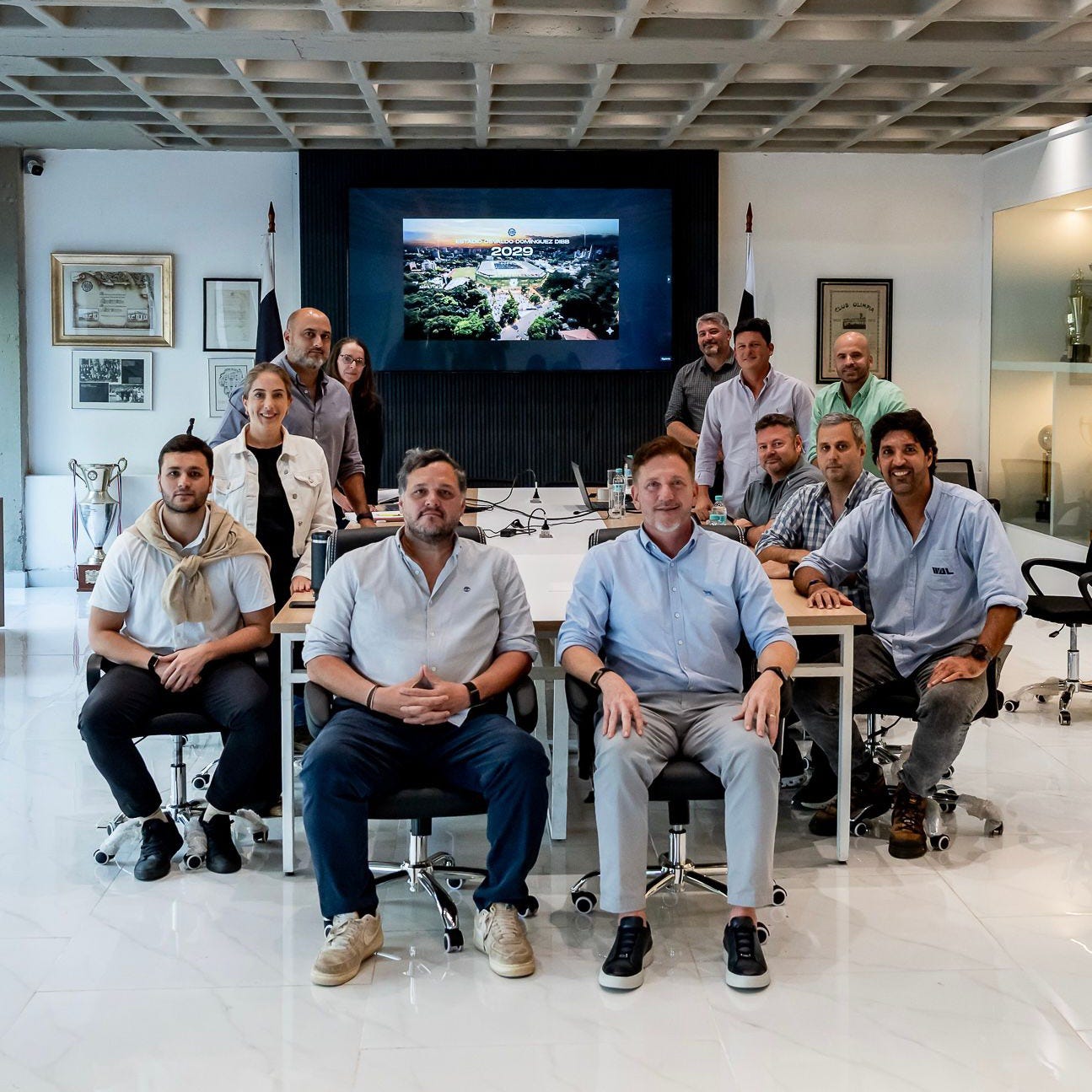
In 1965 the stadium opened its doors with a friendly against Santos and Pelé, now it will be used for Paraguay’s first and possibly only World Cup match. Less than a month after being confirmed as the Paraguayan venue at the FIFA Congress, Alejandro Domínguez’s ties to his father’s former club were strengthened through his son Alejandro Domínguez Pérez. The architect was named as part of the Olimpia board that is now in charge of overseeing this monumental construction project. It is a tall task and a hugely expensive one, even with the CONMEBOL financial support of around US$30 million.
At the club’s annual assembly held earlier this month it was confirmed that the expected cost of the stadium will be US$80 million. As the 2026 World Cup came around, Olimpia’s old ground had been demolished but not much else has taken place. One problem, similar to many traditional English clubs, is that the stadium sits in prime Asunción real estate and extra land for the expansion is hard to come by. After the Armed Forces refused to sell part of their land that sits on the western side of the stadium in 2025, the board had to seek approval from members to purchase acreage on the eastern side this year.
Olimpia insist that everything is going to plan, the completion date set for 2029 will be met. But last year the proposed foundation work never materialised and it seems that Alejandro Domínguez had to step in. In February 2026 an agreement was officially reached with a construction partner, the Brazilian-based Arena events+venues. This firm has worked on 25 World Cup stadiums at the 2014, 2018 and 2022 editions. They crucially had a partnership with CONMEBOL from 2018 to 2022. In March of this year the Argentinian architecture firm Path Urban confirmed they would be in charge of designing Olimpia’s stadium alongside designer Nicole Hellmers.
That same pair had originally been contracted by Olimpia way back in April 2024 to expand the stadium ready for the Copa Sudamericana final. However, after CONMEBOL had announced Asunción as host city the game itself was eventually handed to La Nueva Olla home of Cerro Porteño. A month after the final came the surprise FIFA announcement in Zurich. The original designs had to be remodelled and agreements renegotiated, something that seems to have taken 18 months to transpire.
SO WHY 64 TEAMS?
The issue seems to be that one game simply isn’t going to be enough to attract the estimated $35 million shortfall to complete Paraguay’s most ambitious sporting project ever. An expanded competition would mean more matches and those games could be shared across the three CONMEBOL nations. Rather than the Albirroja playing a single match, why don’t they play their whole group at the newly refurbished Osvaldo Domínguez Dibb stadium?
CONMEBOL first raised the possible expansion last year during a FIFA Council meeting. At the time UEFA President Aleksander Ceferin wasn’t convinced and called it a “bad idea”. The CONCACAF President Victor Montagliani has shared similar views and it is telling that a 64 team proposal wasn’t accepted in May 2025 when the 75th FIFA congress was held in Paraguay.
But it seems Alejandro Dominguez has become deeply invested because of the legacy it will leave for him and his family name either way. On the one hand he can eclipse his father who brought the Copa Libertadores glory to Olimpia, there is nothing bigger in football than the World Cup. On the other hand, imagine the shame if the stadium wasn’t completed and CONMEBOL have to scramble the renovation of the Defensores del Chaco national stadium or worse still forfeit the hosting opportunity. Domínguez is on a mission that is too big to fail.
The emotional need for this decade-long plan to work out may have led the 54-year-old to proclaim a 64-team tournament on his personal social media channels before FIFA has publicly agreed to anything. One of the most influential men in world football is committed to driving the conversation of expanding the expanded World Cup into the heart of South America. It will be interesting to see how the 2030 journey ends.